Enhancing Spain's border security with Entry/Exit System (EES)
Overview
The EU Entry/Exit System (EES) replaces manual passport stamping with a digital biometric record for non-EU nationals on short stays. On their first visit, travelers crossing an external Schengen border provide fingerprints and a facial image; the system then verifies each subsequent entry and exit against that stored record.
Spain operates one of the most demanding EES environments in Europe. Positioned at a primary EU frontier with Africa across the Strait of Gibraltar, it handles substantial international travel volumes across both air and sea borders. Following Brexit, British citizens became third-country nationals, leading to a significant increase in EES-relevant arrivals at Spanish border points.
Fingerprints provide unique, stable identifiers that enable accurate matching at a national scale — which is why the EES requires them alongside the facial image as a mandatory biometric.
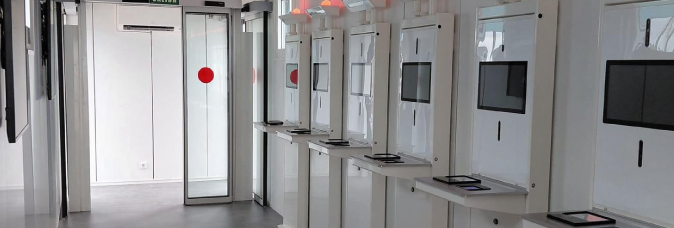
Inetum is deploying the EES at 12 border points in Spain — 7 airports and 5 seaports — encompassing more than 315 self-service kiosks and 148 eGates. The system is live at 7 airports and 3 seaports, with the final two seaports in deployment. The RealScan S60 handles fingerprint enrollment at the kiosks and supports identity verification at the eGates across all 12 sites.
Customer and challenges
The Cuerpo Nacional de Policía (CNP) is responsible for border control at Spain's airports and seaports. Deployment proceeds in phases: first at international airports, then at seaports. The 7 airports and 3 seaports are now live; the final 2 seaports are in progress. At every site, the CNP had to maintain security, regulatory compliance, and passenger throughput.
The EES adds fingerprint and facial capture to every border crossing — a step that increases processing time per traveler and, at high-volume sites, translates directly into queues. To protect throughput, the CNP deployed self-service kiosks and eGates, shifting capture to unattended devices that allow a single officer to supervise six units simultaneously.
International airports
International airports concentrate arriving and departing travelers in the passport control area, where self-service kiosks stand in parallel rows or clusters. Each kiosk and eGate operates as a fixed station connected to the central border management system. Arrival waves bring hundreds of travelers into the area within minutes — the CNP needed parallel processing capacity to absorb them, and every station had to deliver consistent image quality through continuous daily use.
International seaports
Seaports distribute border processing across multiple terminals and berths. Two passenger streams arrive simultaneously and require separate handling: foot travelers walk from the vessel to a designated immigration point, while vehicle travelers register at a separate point in the same manner.
Seaport traffic follows the ferry schedule, and seasonal peaks — such as the summer crossings between Spain and Morocco — can multiply passenger volumes within weeks. Therefore, CNP required a portable solution with EES stations that could be relocated within the port and quickly returned to service at each new location.
Five challenges for the fingerprint scanner
Spain's EES program placed five distinct requirements on the fingerprint scanner — spanning image quality, operational resilience, security, hardware integration, and program-wide standardization.
• Deliver high-quality four-finger fingerprint images for EES enrollment.
• Maintain reliable performance under high-volume operation.
• Detect and reject fake fingerprints at unmanned capture points.
• Integrate into slim kiosks and eGates with a space-saving design.
• Operate as a single scanner model across all 12 sites.
Solution
Inetum is a European digital services and systems integration company with experience in automated border control and biometric systems. Inetum is one of four officially approved EES system providers in Spain. To achieve this designation, Inetum completed a certification process conducted by the CNP, covering both hardware and software components of the proposed solution.
Xperix and Inetum have worked together on digital identity projects for many years, exchanging lessons from those deployments to shape the approach for Spain's EES program.
The project started at the airports and expanded to the seaports. Inetum selected the RealScan S60 for both stages of the rollout.
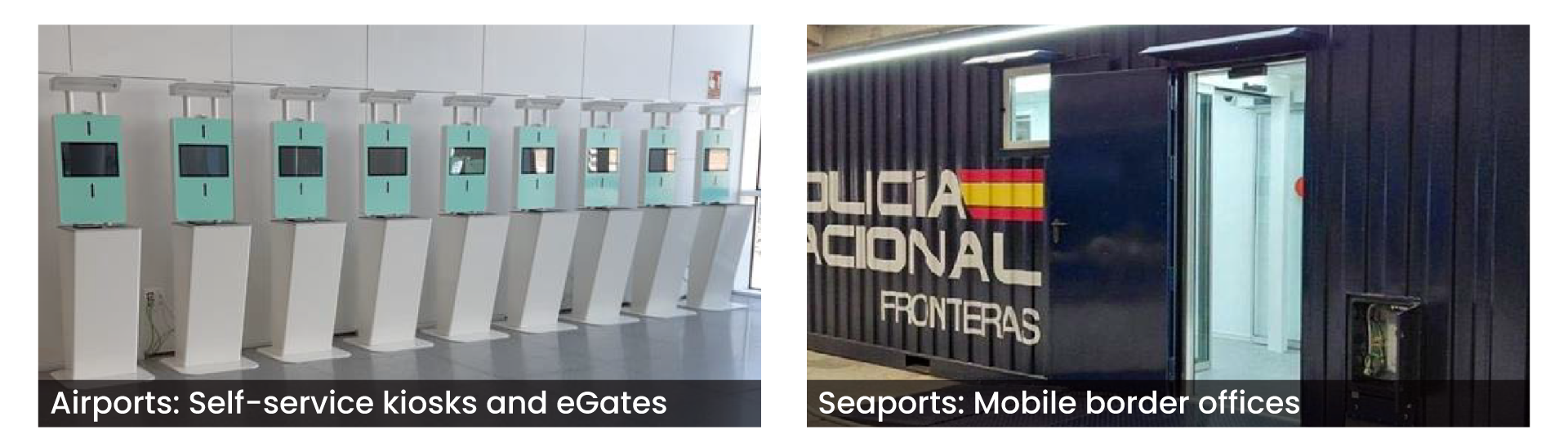
Airports: self-service kiosks and eGates
At the kiosks, first-time travelers register — the RealScan S60 captures four fingerprints to create the traveler's EES record. At the eGates, returning travelers verify their stored fingerprint or face at entry and exit. Both station types repeat the same capture cycle thousands of times each day, in a low-supervision model. In this environment, consistent capture performance under high-frequency daily use is what matters most. The RealScan S60 delivers this in both configurations.
Seaports: self-service kiosks in mobile border offices
Seaport environments experience seasonal fluctuations in passenger volumes and frequent changes to docking arrangements. Border control locations may need to be relocated to meet operational requirements, making permanent infrastructure impractical.
Inetum addressed this by deploying mobile border offices — containerized units that can be relocated quickly while maintaining operational continuity. Each container houses self-service kiosks and moves with the active berth. Space inside the containers is limited, so each kiosk had to remain compact. The RealScan S60's 19.3 mm form factor enabled integration into the kiosk design without structural modifications.
Why the RealScan S60
1. Image quality verified by NFIQ 2.0
The RealScan S60 captures four-finger images that satisfy EES biometric criteria. Xperix's fingerprint recognition algorithm compensates for slippage, blur, and halo conditions at the point of capture, ensuring high-quality image acquisition on the first attempt. Image quality is then verified against NFIQ 2.0 standards through the RealScan SDK.
2. Consistent performance under high-volume operation
The RealScan S60 maintains fast fingerprint capture speeds across sustained, high-volume use — processing each traveler without delay regardless of passenger flow. The RealScan SDK ensures consistent throughput by minimizing the operational impact of smudges, oils, and environmental factors that accumulate on the platen surface over continuous operation. The platen's IP65-rated construction supports long-term reliability at high-traffic checkpoints.
3. Liveness detection
The RealScan S60 is the first FAP60 scanner in the world to obtain both PAD Level 1 and Level 2 (ISO/IEC 30107-3). In the context of EES, liveness detection is fundamental — a compromised fingerprint at enrollment corrupts the biometric record that subsequent border crossings rely on. The RealScan S60 detects and rejects fake fingerprints made from materials such as clay, rubber, silicone, glue, paper, film, and more, protecting the integrity of the identity record from the point of first capture.
4. Compact, integration-friendly hardware
At 19.3 mm thin, the RealScan S60 fits into compact enclosures without requiring structural modifications to the host device. This enabled Inetum to integrate the scanner into both standard kiosks and the space-constrained mobile border office units.
5. One scanner model across all 12 sites
The same RealScan S60 operates in kiosks and eGates across all 12 sites. Standardizing on a single model reduced procurement complexity and long-term maintenance overhead across the full program.
Results
The system is live and operational at 10 of the 12 sites — 7 airports and 3 seaports — with deployment ongoing at the remaining two seaports, Algeciras and Barcelona.
Spain's EES deployment is among the most operationally complex in Europe, spanning fixed infrastructure at major international airports and mobile border offices at seaports. This nationwide program effectively operationalizes the EU's strategic shift from manual passport stamping to a digital, biometric-driven border management system that all subsequent border crossings will rely on.
The deployment covers 315 self-service kiosks, 148 eGates, and 10 mobile containers across the 12 sites. At enrollment, the RealScan S60 captures the four-finger records that every subsequent crossing is verified against. Program-wide, this capture anchors each traveler's EES identity and supports the integrity of Spain's biometric border infrastructure.
According to the local Spanish media outlet La Opinión de Murcia, Murcia International Airport has processed approximately 500,000 non-EU passengers since implementing the EES in October 2025, representing roughly nine months of continuous operation.